

Table of Contents
- What Makes Original Historical Insights for Adults Different
- Historical Research Methods for Enthusiasts
- Untold History Facts UK: Discovering Overlooked Stories
- Unique Historical Perspectives: Applying Critical Thinking
- Deep Dive History Topics: Digital Tools and Resources
- Building Your Own Original Historical Insights Framework
- Conclusion
Last Updated: July 30, 2026
What Makes Original Historical Insights for Adults Different
At Robs Books, we understand that original historical insights for adults go far beyond mainstream textbooks or popular documentaries. Most people consume history through curated channels, television, bestselling books, museums, filtered through editorial decisions and audience assumptions. Original historical insights emerge when you engage directly with primary sources, ask critical questions about whose stories get told, and explore gaps between official records and lived experience.
Research in historical methodology shows that adults pursuing independent historical inquiry develop significantly stronger critical thinking skills. History forces you to evaluate competing evidence, weigh reliability, and construct arguments based on incomplete information, precisely the skills that matter in an uncertain world.
Beyond mainstream narratives
Mainstream historical narratives emphasise major events, famous figures, and dramatic turning points, often reflecting the biases of their authors by excluding the experiences of women, working people, colonised populations, and ordinary individuals whose lives shaped their times just as much as kings and battles did.
When you pursue original historical insights for adults, you deliberately step outside established narratives. You might discover that a supposedly insignificant local event reveals profound truths about how ordinary people experienced major historical shifts, or that the "official" version contradicts what primary sources actually say. Rather than accepting what you're told about history, you become an active participant in historical discovery. Robs Books recognises this hunger for authentic, unconventional perspectives, which is why we curate collections highlighting overlooked stories and original historical insights for adults that challenge standard narratives.
The role of independent research
Independent research doesn't require academic credentials, only curiosity, persistence, and willingness to follow evidence wherever it leads. Digital archives, open-access databases, and online collections have democratised historical research, making documents once requiring travel to specific archives now searchable from home. Yet this abundance creates a challenge: how do you distinguish genuine historical insight from speculation or bias?
Independent research requires developing quality filters. Ask: Who created this source and why? What perspective are they bringing? What evidence supports this claim? What alternatives might explain the same facts?
Historical Research Methods for Enthusiasts
Developing original historical insights for adults requires understanding the tools and approaches that professional historians use, then adapting them for your own inquiry.
Primary source analysis
Primary sources are the raw material of history: documents created during or immediately after the events they describe, including letters, diaries, government records, newspapers, photographs, artefacts, and court transcripts. Analysing primary sources means asking specific questions: What type of source is this? Who created it and for what audience? What does it reveal about the creator's perspective and assumptions? What was happening when this was created?
Consider a Victorian newspaper article about a factory strike. The article itself is a primary source, but so is what it doesn't say. The newspaper owner had financial interests. The reporter had access to certain voices (factory owners, police) but not others (striking workers). The language used, describing workers as "agitators" versus "desperate families", reveals bias. By reading critically, you uncover not just what happened, but how power shaped the telling. When you work with primary sources, you're building original historical insights for adults because you're doing the interpretive work yourself, encountering history directly, messy and complicated as it actually was.
Archival research fundamentals
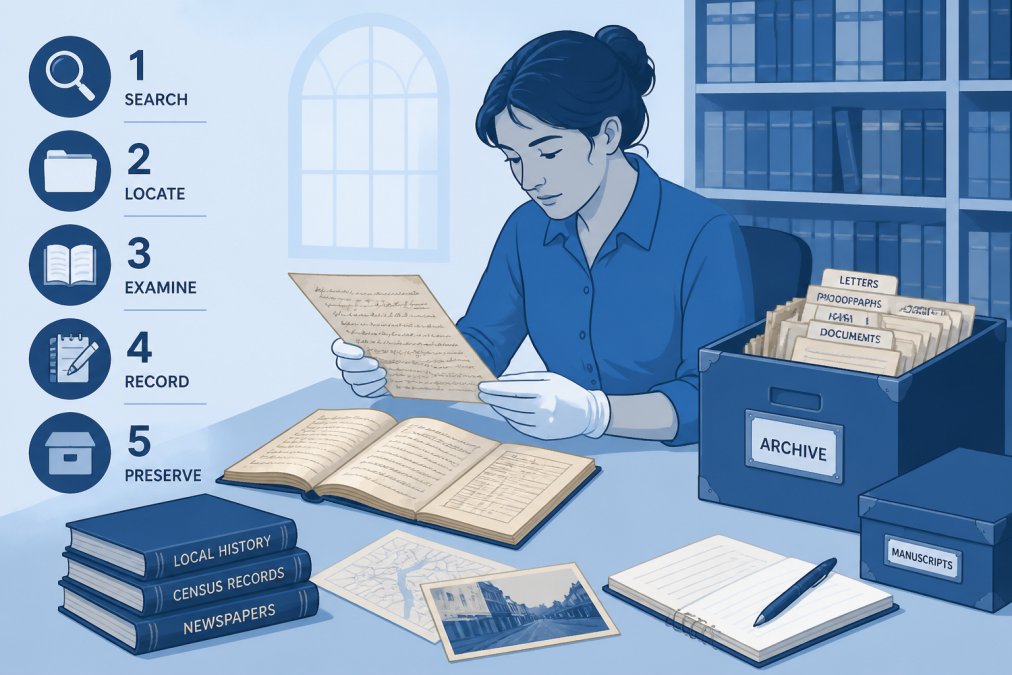
Archives are repositories of primary sources: government offices, local history societies, university special collections, museum archives, and private collections. Most archives maintain catalogues, increasingly available online, describing their holdings. Archival research begins with knowing what exists through searching catalogues for relevant collections, then requesting access. Some archives allow online browsing; others require in-person visits.
Practical steps include identifying relevant archives, searching their online catalogues, contacting archivists with specific questions, requesting access, taking detailed notes and photographs (where permitted), and cross-referencing materials to build a fuller picture. Archivists are usually generous with their time if you approach them with thoughtful questions.
Oral history and firsthand accounts
Oral history, recorded interviews with people who lived through significant events, captures perspectives that official records often miss: what it felt like, what people actually worried about, what decisions seemed important at the time. Existing oral history projects preserve thousands of interviews: Holocaust survivors, veterans, civil rights activists, ordinary workers. These collections offer original historical insights for adults because they capture voices that might otherwise be lost.
If you're conducting your own interviews, research your subject beforehand, develop open-ended questions that encourage storytelling, record and transcribe the interview (with permission), and share transcripts with your subject for accuracy.
Untold History Facts UK: Discovering Overlooked Stories
British history is far richer and stranger than most people realise. Beneath familiar narratives of kings, wars, and industrial progress lie countless stories that shaped the nation but rarely appear in mainstream accounts.
Local and regional histories
Every town, village, and city has a history extending far beyond what appears in national histories. Local archives, parish records, and community collections preserve details of ordinary life: who lived where, what they did for work, how communities responded to major events. Local history research often reveals that national events played out very differently depending on location. A war that seemed decisive nationally might have barely touched some communities while devastating others.
Pursuing local and regional histories produces original historical insights for adults because you're working with sources few people have examined. Starting points include local studies libraries, parish councils, historical societies, and community archives.
Everyday life and social history
Social history focuses on how ordinary people lived: what they ate, how they worked, what they believed, how they celebrated, how they struggled. Everyday life leaves traces in unexpected places. Recipe books reveal what people could afford. Children's schoolbooks show what authorities wanted young people to believe. Shop ledgers document consumer habits. Court records preserve conflicts between neighbours.
Social history often produces surprising original historical insights for adults. You might discover that Victorian working-class families had more leisure time than assumed, or that medieval peasants had legal rights they could enforce. These discoveries matter because they complicate simple narratives and restore agency to people history often treats as passive victims.
Unique Historical Perspectives: Applying Critical Thinking
Developing original historical insights for adults requires more than gathering information. It requires thinking carefully about how you interpret what you find.
Historical psychology and human behaviour
History is ultimately about human beings, their motivations, beliefs, fears, and choices. Understanding historical psychology means recognising that people in the past weren't fundamentally different from us, but operated within different circumstances and assumptions. This prevents romanticising the past and dismissing it as irrelevant. When you examine historical psychology, you discover patterns that repeat across centuries: how people respond to uncertainty, how communities facing threat sometimes unite and sometimes turn on internal scapegoats, how individuals facing impossible choices often surprise themselves with their own resilience or failures.
Applying psychological insight to history produces original historical insights for adults because it moves beyond "what happened" to "why people did what they did," seeing historical actors as complex human beings rather than characters in a predetermined story.
Cultural history frameworks
Cultural history examines how people created meaning through art, music, literature, ritual, celebration, and everyday practices. A single cultural object, a painting, song, building, or fashion, can reveal layers of historical insight. Why did people find this beautiful or meaningful? What does it tell us about what they valued, feared, or desired?
Cultural history frameworks help you organise these insights. You might examine how a particular period expressed anxiety through its art, trace how a cultural practice changed over time and what those changes reveal about shifting values, or compare how different communities expressed similar concerns through different cultural forms. This approach produces original historical insights for adults because it takes seriously the inner lives and creative expressions of people in the past.
Distinguishing historical fiction from factual record
One of the most important critical thinking skills for historical inquiry is distinguishing what we actually know from what we imagine, assume, or reconstruct. Historical fiction can convey the texture of life in a particular era in ways academic history cannot, but it's still fiction; the author has invented dialogue, internal thoughts, and sometimes events themselves.
When you pursue original historical insights for adults, verify claims against primary sources and recognise where the author filled gaps with invention. The same applies to popular history books, documentaries, and museums. Developing critical reading skills means asking: What evidence supports this claim? What alternative interpretations exist? What perspectives are missing? What biases might shape this presentation?
Deep Dive History Topics: Digital Tools and Resources
The digital revolution has transformed historical research. Tools and resources that didn't exist a decade ago now make it possible to pursue original historical insights for adults from anywhere.
Open access academic databases
Universities and research institutions have increasingly made scholarly resources available to the public. The British Library Online Collections include millions of digitised items: manuscripts, printed books, maps, photographs. The National Archives provides access to government records. Many local studies libraries have digitised their collections. Beyond British institutions, international resources expand your reach: Google Books has scanned millions of volumes, the Internet Archive preserves vast collections of digitised materials, Project Gutenberg offers free access to texts in the public domain, and Europeana aggregates digitised cultural heritage from across Europe.
Using these resources requires developing search skills. Knowing what keywords to use, understanding how different databases organise materials, and learning to read digitised documents that might be faint or damaged become practical skills that improve your research efficiency.
Digital synthesis and note-taking
As you gather sources, you face a challenge: how do you organise and make sense of large volumes of material? Note-taking systems range from simple (a spreadsheet tracking sources and key quotes) to sophisticated (database systems allowing you to tag, cross-reference, and search your notes). What matters is developing a system that works for you. Capture not just facts but your own observations and questions. Note where you found information so you can return to sources. Create connections between different sources; this is where original historical insights for adults often emerge.
| Digital Tool Type | Best For | Key Benefit |
|---|---|---|
| Spreadsheets | Simple projects, tracking sources | Easy to search and sort |
| Note-taking apps | Capturing ideas, organising by theme | Accessible across devices |
| Database systems | Complex projects, cross-referencing | Powerful searching and linking |
| Mind mapping | Visualising connections | Reveals patterns and relationships |
Building Your Own Original Historical Insights Framework
As you develop skills in historical research and critical thinking, you're building a personal framework for understanding how history works and what it teaches.
Developing historiography skills
Historiography is the study of how history is written, how historians interpret evidence, construct narratives, and build arguments. Every historian makes choices about what sources to prioritise, how to interpret ambiguous evidence, and what narrative framework to impose on events. Different historians working with the same sources can reach different conclusions. This doesn't mean all interpretations are equally valid; some arguments rest on stronger evidence, some interpretations account for more sources and perspectives, and some historians are more transparent about their assumptions.
Developing this awareness means reading historiography, comparing different historians' accounts of the same events, and examining your own biases. Learn to argue for your interpretation while acknowledging alternatives.
Common mistakes to avoid in historical inquiry
Several patterns repeatedly undermine historical research. Assuming sources are objective ignores that every source reflects the perspective of whoever created it. Treating absence as evidence mistakes silence for proof. Imposing modern values on the past prevents understanding why beliefs made sense given what people knew at the time. Oversimplifying causation ignores that historical events have multiple interconnected causes. Confusing correlation with causation requires careful analysis of mechanisms and evidence. Selecting sources to confirm what you already believe prevents genuine discovery.
History isn't something that happened to other people in distant times. It's the accumulated experience of human beings navigating challenges, making choices, and creating meaning. Pursuing original historical insights for adults means engaging directly with that experience, asking your own questions, examining sources yourself, and thinking critically about what the past reveals.
The skills you develop, evaluating evidence, recognising bias, constructing arguments, revising your understanding, matter far beyond history. They're the skills of thinking clearly in an uncertain world. At Robs Books, we believe that genuine historical inquiry enriches not just your knowledge but your capacity to understand complexity, challenge assumptions, and engage thoughtfully with the world around you. Whether you're exploring overlooked local stories, examining primary sources, or building your own historical interpretations, the pursuit of original historical insights transforms how you see both past and present.
Frequently Asked Questions
What are some untold history facts UK that most people don't know about?
British history extends far beyond the monarchy and major wars. Many overlooked stories exist in local archives, including everyday accounts of ordinary people during significant periods. Community histories, industrial heritage, migration patterns, and the lived experiences documented in letters and diaries reveal aspects of British society rarely covered in mainstream narratives. Regional museums and local history societies often hold unique historical insights that challenge conventional understanding of specific periods and places.
How can I find unique historical perspectives as an adult learner?
Unique historical perspectives emerge from engaging with primary sources directly rather than relying solely on secondary accounts. Explore archival research through local record offices, examine firsthand accounts and oral histories, and apply cultural history frameworks to understand historical context. Digital tools now make accessing these materials easier. Critical thinking about historical psychology and human behaviour helps you develop original interpretations. Consider how different socio-cultural worlds intersected during historical events, which often reveals perspectives overlooked in traditional historiography.
What's the difference between historical fiction and factual historical record?
Historical fiction uses real events as a backdrop but prioritises narrative construction and character development, sometimes altering facts for storytelling effect. Factual historical record relies on empirical evidence, documentary evidence, and scholarly research grounded in primary sources. When seeking original historical insights, distinguish between these by checking citations, examining source documentation, and consulting academic databases. Historians use rigorous research methodology to verify claims, whereas fiction authors may take creative liberties. Understanding this distinction is crucial for building historical literacy and credibility in your own research.
What historical research methods for enthusiasts don't require formal academic training?
Non-academics can employ several effective research methodologies: analyse primary sources by reading letters, newspapers, and official documents with a critical eye; conduct oral history interviews with elderly relatives or community members; explore local archival collections at record offices and libraries; and use open access academic databases now freely available online. Develop historiography skills by reading how historians construct arguments about evidence. Start with topics connected to your own community or interests, which makes research more engaging. Digital tools for synthesising information help organise your findings. Many historical societies offer guidance for amateur researchers without requiring credentials.
This article was written using GrandRanker
0 comments