

Table of Contents
- Understanding Hidden History and Where to Find It
- Obscure History Books UK: Independent Bookshops and Specialist Retailers
- Local History Archives UK: Accessing Primary Sources and Regional Records
- Historical Research Methods UK: Verifying Accuracy and Evaluating Sources
- Rare History Books UK: Antiquarian Dealers and Second-Hand Sources
- Online Platforms and Digital Archives for Hidden History
- Building Your Hidden History Collection: Curated Recommendations and Next Steps
- Conclusion
Where to Find Hidden History Books: A UK Guide
Last Updated: July 29, 2026
Understanding Hidden History and Where to Find It
Hidden history books challenge conventional narratives and explore forgotten perspectives that mainstream publishers overlook. At Robs Books, we understand that readers seeking authentic historical insight struggle to locate these gems, scattered across independent shops, archives, specialist dealers, and digital collections most people never explore.
The challenge isn't that hidden history books don't exist, they're deliberately obscure. Academic presses print limited runs. Regional publishers focus on local audiences. Antiquarian dealers stock rare editions that never reach online marketplaces. Digital archives remain invisible to casual browsers. Discovering genuine historical narratives backed by primary sources rather than speculation requires a deliberate search strategy.
Below, we'll show you how to navigate every avenue for finding hidden history books in the UK, from county record offices holding centuries of local documents to online platforms housing digitised collections rivalling major libraries. Whether researching lost civilisations, uncovering secret origins of historical events, or seeking overlooked historical figures, these methods connect you with authentic sources revealing what mainstream publishers ignore.
Obscure History Books UK: Independent Bookshops and Specialist Retailers
Independent bookshops remain the most reliable source for obscure history books across the UK. Unlike chain retailers stocking based on sales algorithms, independent booksellers curate collections with genuine expertise, maintaining relationships with small presses and actively seeking titles deserving readership beyond their initial print run.
Find shops with dedicated history sections and staff understanding the difference between pop-history speculation and rigorous analysis. Many independent retailers now maintain searchable online catalogues. The Bookseller's Association website provides a directory of independent members across the UK, many specialising in particular genres or periods.
Specialist retailers focusing on folklore, archaeology, and regional history stock titles from university presses, small heritage publishers, and self-published works by academics and local historians that would never appear in chain stores. Staff provide expert recommendations directing you toward overlooked titles and explaining why certain books matter within their field.
Many independent retailers now offer online ordering with free UK delivery. Several specialise in particular regions or historical periods, searching for "Victorian history books UK" or "Scottish archaeology specialists" often yields shops with deep collections in those areas.
Local History Archives UK: Accessing Primary Sources and Regional Records
Local history archives represent the richest source of authentic hidden history, yet remain largely unknown outside academic and genealogical circles. These institutions house primary documents, original letters, photographs, land records, court proceedings, and administrative files forming the foundation of genuine historical research. Archive materials offer direct access to how people actually lived, thought, and recorded their experiences.
County record offices and local studies libraries
Every English county maintains a record office holding documents spanning centuries. These are public institutions with trained staff and increasingly digitised collections. County record offices typically hold land deeds, wills, quarter sessions records, maps, photographs, and local newspapers. Researchers examining these materials can reconstruct local events, family histories, and economic patterns that published histories overlook.
Access is free or low-cost. Most record offices require advance booking for research sessions, though many now offer remote access to digitised collections. The National Archives in Kew holds national-level documents and maintains a searchable catalogue online. Regional studies libraries, often within public library systems, complement record offices by housing published local history works, maps, and periodicals alongside archival materials.
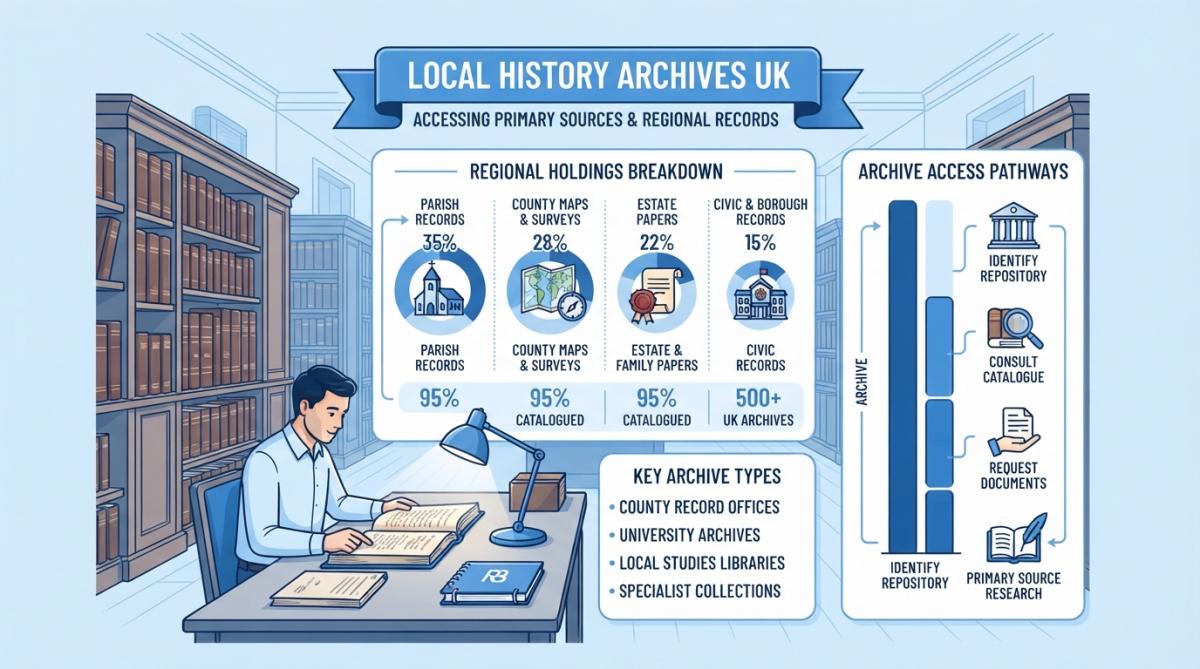
Identify your local record office through the Archives and Records Association directory. Contact them to understand their collections and access procedures. Many specialise in particular themes, industrial heritage, agricultural history, migration patterns, and staff can guide you toward materials relevant to your research.
Digital collections and online portals
Digitisation projects have transformed access to hidden history. The National Archives Discovery catalogue provides online access to millions of documents. British History Online hosts full texts of Victoria County Histories, medieval chronicles, and regional studies. Local Studies Online connects users to digitised collections held by local authorities across England and Wales.
University libraries increasingly digitise special collections and make them publicly available. The Internet Archive holds millions of digitised books, including obscure historical works and out-of-print titles, many fully searchable. Scotland, Wales, and Northern Ireland maintain their own archival systems through the National Records of Scotland, the National Library of Wales, and the Public Record Office of Northern Ireland, all offering online catalogues and growing digital collections.
Historical Research Methods UK: Verifying Accuracy and Evaluating Sources
Distinguishing rigorous historical analysis from speculative fringe theories is essential. Not all obscure books are obscure because they're suppressed truth; many lack credible evidence or make unsupported claims.
Distinguishing academic history from popular speculation
Academic historians follow specific methodologies: they cite primary sources, acknowledge limitations in evidence, and engage with existing scholarship. Their work appears in peer-reviewed journals, university press publications, and monographs with extensive bibliographies. When evaluating a hidden history book, examine whether the author cites specific documents, explains their interpretation of evidence, and acknowledges alternative interpretations.
Check whether the author has academic credentials in history or a related field. Look for institutional affiliations, university positions, research centre roles, or museum curatorships. Examine the bibliography, a work with extensive notes citing primary sources demonstrates different rigour than one with handful of secondary sources. Read reviews in academic journals rather than consumer platforms.
Using primary sources and archival research
Understanding how to read primary sources prevents misinterpretation. A letter written in 1823 reflects the writer's perspective and immediate circumstances, not objective truth. Court records document what magistrates decided, not necessarily what happened. Photographs show what the photographer chose to frame.
Effective archival research requires cross-referencing. Multiple sources, letters, official documents, photographs, newspaper accounts, create a more complete picture than single sources. When discovering a hidden history claim, trace it back to its sources. Claims supported by multiple independent sources prove more reliable than those relying on single documents.
Learn to read documents in their original context. Understanding the administrative purpose of a record, the conventions of the time period, and the writer's position helps you interpret meaning accurately. Archive staff can often explain these contexts, and many record offices offer research guides for particular document types.
Rare History Books UK: Antiquarian Dealers and Second-Hand Sources
Antiquarian and second-hand booksellers stock titles gone out of print, making them essential for accessing hidden history published decades or centuries ago. These dealers range from individual collectors selling online to established shops with expertise in particular fields.
Vialibri and AbeBooks aggregate listings from thousands of second-hand booksellers across the UK and internationally, allowing you to search by title, author, or subject and compare prices and availability. Biblio similarly connects independent booksellers. These platforms make locating specific titles possible without visiting multiple shops.
Established antiquarian dealers often specialise in particular periods or themes, medieval manuscripts, Victorian ephemera, natural history, regional studies. Dealers with subject expertise advise on which editions matter historically and alert you to new acquisitions. The Antiquarian Booksellers' Association directory lists members across the UK, many welcoming enquiries from researchers.
Book fairs held across the UK bring together dozens of dealers in one location. The London Antiquarian Book Fair, held twice yearly, attracts dealers specialising in history, archaeology, and regional studies. Regional fairs occur throughout the year in Edinburgh, Manchester, and Bristol.
Second-hand copies of out-of-print academic works often cost far less than original editions while remaining identical in content. Many university libraries sell withdrawn books through online auction platforms and charity shops.
Online Platforms and Digital Archives for Hidden History
Digital platforms have fundamentally changed access to hidden history, making materials previously available only through physical visits now searchable from home.
National and regional digital library databases
The British Library's online collections include manuscripts, maps, printed books, and sound recordings. The Wellcome Library holds extensive collections on the history of medicine, science, and society. The Bodleian Library at Oxford and Cambridge University Library provide online access to millions of items. The Internet Archive's Open Library project aims to create a web page for every book ever published, with millions of historical books fully digitised and searchable.
Regional initiatives digitise local collections. Many local studies libraries have digitised local newspapers, maps, and photographs. The British Newspaper Archive provides searchable access to digitised newspapers from across the UK, allowing you to research specific events and time periods through contemporary accounts.
Specialist online communities and research forums
Online communities dedicated to particular historical periods, regions, or research interests share knowledge and resources. Forums focused on local history, genealogy, and archaeology connect researchers and often include recommendations for lesser-known books and archival sources.
Academic social networks like ResearchGate and Academia.edu allow researchers to share their work directly. Many academics post papers and articles that might otherwise remain locked behind paywalls. Specialist history podcasts and blogs frequently recommend hidden history books within their episodes and posts.
Building Your Hidden History Collection: Curated Recommendations and Next Steps
Developing genuine understanding of hidden history requires prioritising works demonstrating scholarly rigour, engaging with primary sources, and challenging conventional narratives through evidence rather than speculation.
Start with foundational works in your area of interest. Academic surveys and monographs provide context and identify key debates within the field, with extensive bibliographies pointing toward more specialised works. Combine published works with direct archival research, reading about a historical event in a book, then examining primary documents from that period, deepens understanding immensely.
Robs Books offers a diverse collection including historical works alongside folklore, providing valuable context for understanding how historical narratives develop. The shop's selection of original works by Robin Wickens includes unique historical insights complementing conventional academic sources, offering perspectives combining storytelling with genuine historical inquiry.
Build relationships with librarians, archivists, and booksellers in your area of interest. These professionals know where hidden history lives, in obscure corners of collections, specialist publications, and materials not yet digitised. Document your sources as you build your collection, noting which books led you to which archives and which primary documents supported which claims.
| Resource Type | Best For | Access Method |
|---|---|---|
| County record offices | Primary documents, local history | In-person or remote access |
| University digital collections | Full-text historical works | Online searchable databases |
| Antiquarian dealers | Rare and out-of-print titles | Online catalogues or in-person |
| Independent bookshops | Expert recommendations, obscure titles | In-person or online ordering |
| Online archive platforms | Digitised newspapers, manuscripts | Keyword searchable |
| Academic journals and monographs | Peer-reviewed scholarship | University libraries or purchase |
Finding genuine hidden history books requires moving beyond retail shelves and search algorithms to engage directly with archives, independent specialists, and digital collections preserving materials the mainstream ignores. The resources outlined here, from county record offices holding centuries of documents to online platforms making rare works searchable, exist to serve researchers willing to invest time in rigorous exploration. Robs Books supports this journey by offering carefully selected historical works combining authentic inquiry with engaging narrative, providing a starting point for readers wanting hidden history grounded in evidence rather than speculation.
Frequently Asked Questions
What exactly are hidden history books and how do they differ from mainstream historical narratives?
Hidden history books explore overlooked, suppressed, or lesser-known perspectives on historical events and figures. Unlike mainstream historical narratives, which tend to focus on well-documented events and prominent figures, hidden history delves into untold stories, marginalised communities, and secret origins of major events. The key difference lies in the sources used and the narratives prioritised. Academic hidden history relies on primary sources and archival research, whilst popular hidden history sometimes incorporates speculation. When seeking hidden history books, verify whether the author uses documented evidence or relies on conjecture to distinguish rigorous historical analysis from entertainment-focused speculation.
How can I verify the accuracy of hidden history books I find?
To verify accuracy, check whether the author cites primary sources and provides a bibliography. Academic publishers and university presses typically employ rigorous peer review, whereas self-published or fringe works may lack editorial oversight. Cross-reference claims against established archives and historical records held in UK county record offices or the British Library. Look for books published by reputable academic publishers rather than vanity presses. Read reviews from academic historians and check whether the book has been reviewed in scholarly journals. When researching local or regional hidden history, consult your local studies library, which can confirm whether claims align with documented regional records.
Where can I find rare history books and obscure history books in the UK?
Rare and obscure history books are available through antiquarian booksellers, second-hand specialist retailers, and online platforms dedicated to out-of-print works. Independent bookshops often stock curated selections of obscure titles that larger chains do not carry. Online marketplaces and auction sites specialise in rare editions. University libraries and specialist academic bookshops also stock obscure historical research. Local history archives and county record offices sometimes sell or recommend publications on regional topics. For truly rare volumes, contact antiquarian dealers who specialise in historical research materials, they can often locate specific titles through their networks.
What are the best digital archives and online resources for researching hidden history in the UK?
The British Library, the National Archives, and regional county record offices all maintain searchable digital collections. Specialist platforms like Internet Archive and Google Books provide access to out-of-print and obscure historical works. Many local studies libraries have digitised regional records and local history publications available online. Universities often provide public access to certain digital archives. The BBC Archive and local history society websites frequently feature curated collections on regional hidden history. When using digital archives, start with your local authority's online collections, which often include primary sources specific to your area. These resources help you access historical records and verify claims made in hidden history books.
How do I distinguish between academic hidden history and speculative pop-history when choosing books?
Academic hidden history is published by university presses or scholarly publishers, includes detailed citations and bibliographies, and is often peer-reviewed. Authors typically hold academic credentials and acknowledge limitations in available evidence. Pop-history, whilst entertaining, may prioritise narrative appeal over rigorous evidence and sometimes presents speculation as fact. Check the publisher's reputation, the author's qualifications, and whether the book has been reviewed in academic journals. Books focused on 'secret knowledge' or 'suppressed truths' without substantial documented evidence lean toward pop-history. For reliable hidden history, prioritise works that engage with primary sources, acknowledge competing interpretations, and are transparent about what remains unknown or debated among historians.
Are there UK-based organisations or societies dedicated to local and hidden history?
Yes, numerous organisations support hidden history research across the UK. Local history societies exist in nearly every region and maintain archives, publish journals, and organise research groups. County archaeological societies focus on unearthing hidden pasts through excavation and archival work. The British Association for Local History provides resources and connects local historians nationwide. Regional museums often house collections of overlooked historical narratives. The Victoria County History project documents the hidden history of English communities through detailed research. Joining a local history society gives you access to curated collections, expert guidance on research methods, and connections to others exploring forgotten perspectives in your area.
This article was written using GrandRanker
0 comments