

Table of Contents
- Why Adult Colouring Books Matter for Mental Wellbeing
- How Colouring for Anxiety Relief Works
- Cognitive Benefits: Focus, Concentration, and Brain Function
- Creative Expression and Emotional Regulation
- Physical and Sensory Benefits of Colouring
- How to Start a Colouring Hobby
- Adult Colouring Books for Neurodivergence and Special Needs
- Integrating Colouring with Other Wellbeing Practices
Why Adult Colouring Books Matter for Mental Wellbeing
Adult colouring books have emerged as a legitimate tool for mental health and cognitive wellbeing, with growing recognition from both practitioners and individuals seeking alternative approaches to stress management. The practice engages multiple systems simultaneously: your attention narrows to the present moment, your hands perform repetitive fine motor movements, and your brain processes colour and spatial relationships all at once.
Unlike passive relaxation such as scrolling or watching television, colouring demands just enough cognitive engagement to interrupt rumination and intrusive thoughts while remaining accessible enough that it doesn't create new stress. At Robs Books, many readers drawn to our colouring collections describe the activity as meditative without requiring formal meditation training.
Regular colouring practice influences how your brain processes stress over time, affecting emotional regulation, sleep quality, and your ability to maintain focus during demanding tasks. What makes this particularly valuable is that it requires no special equipment, no prior artistic ability, and no significant time commitment.
How Colouring for Anxiety Relief Works
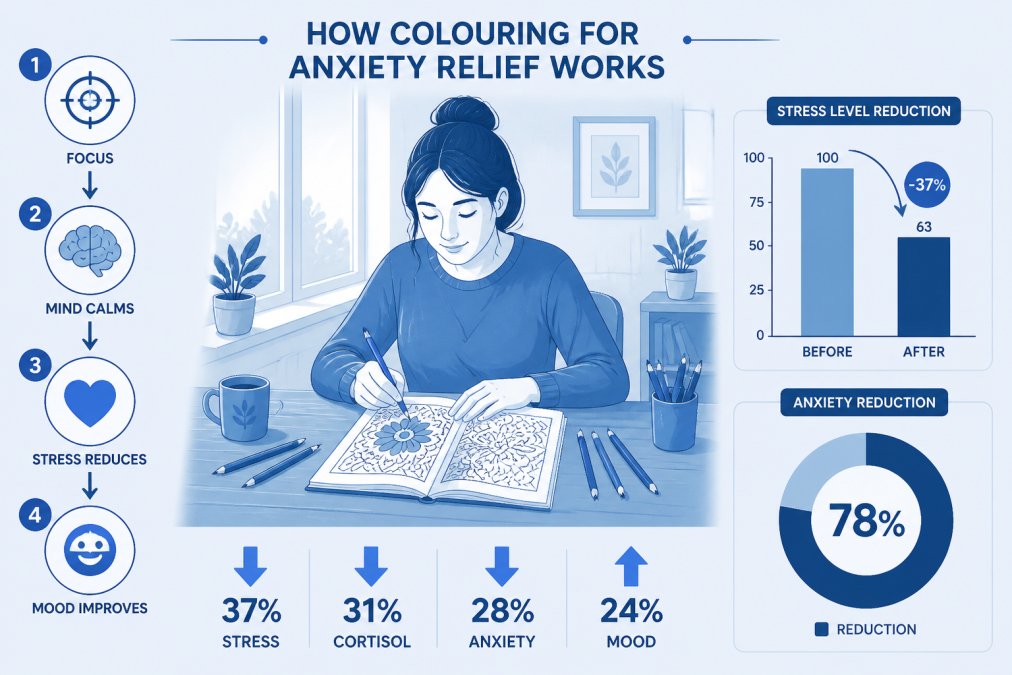
Colouring for anxiety relief functions through several interconnected neurological and physiological pathways. When you engage in colouring, your brain shifts into a state of focused attention that naturally suppresses the neural activity associated with worry and rumination. The repetitive hand movements activate your parasympathetic nervous system, the biological system responsible for your body's relaxation response, which counteracts the fight-or-flight activation that characterises anxiety.
The stress response and cortisol reduction
Your body's stress response involves a cascade of hormonal and neural changes designed to prepare you for immediate threat. When you perceive danger, whether real or imagined, your amygdala triggers the release of cortisol and adrenaline. This response is essential in genuine emergencies but becomes problematic when it activates repeatedly in response to everyday stressors.
Colouring interrupts this cycle by demanding your visual and motor attention simultaneously. Your brain cannot maintain high-level worry whilst processing colour choices, spatial boundaries, and fine motor control. The repetitive, rhythmic nature of colouring creates a calming pattern that your nervous system recognises as safe and predictable.
Research into similar activities, such as knitting and drawing, suggests that repetitive creative tasks reduce cortisol levels and lower heart rate variability, both markers of reduced physiological stress. The sensory experience matters too: the texture of paper, the smell of coloured pencils, and the visual feedback of colour appearing on the page all contribute to grounding your awareness in the present moment.
Mindfulness and meditative states
Adult colouring books create a natural gateway into mindfulness without demanding that you sit in silence or follow formal meditation protocols. As you colour, your attention naturally anchors to the immediate sensory experience: the movement of your hand, the colour you're applying, the emerging pattern on the page.
This focused attention is the essence of a meditative state. Your mind quiets not through forced suppression of thoughts but through genuine engagement with the present activity. The colouring book provides a natural container for your focus, making meditation accessible to people who find traditional mindfulness practice frustrating or ineffective.
The mental clarity that follows colouring sessions reflects this shift in brain activity. By temporarily stepping out of the rumination cycle, you create space for your prefrontal cortex, the region responsible for rational thought and emotional regulation, to reassert itself. Many people report that solutions to problems emerge more readily after colouring, or that anxiety feels more manageable afterwards.
Cognitive Benefits: Focus, Concentration, and Brain Function
Colouring strengthens several cognitive capacities that support overall mental function. The activity demands sustained attention to fine detail whilst maintaining awareness of the broader pattern. Your brain must hold multiple pieces of information simultaneously: the current colour you're using, where you want to apply it next, which areas you've already completed, and how your choices fit the overall design.
This cognitive engagement activates your working memory and visual-spatial processing networks. Over time, regular colouring practice can enhance your ability to maintain focus on complex tasks, particularly for individuals whose attention naturally fragments. The activity also engages your planning and decision-making systems as you choose colour combinations and plan your approach to each page.
For people with neurodivergent profiles, including ADHD and autism spectrum traits, colouring offers particular advantages. The structured nature provides clear boundaries and immediate feedback, which supports executive function. The repetitive, predictable nature reduces cognitive load, allowing the brain to settle into a more regulated state.
Creative Expression and Emotional Regulation
Colouring serves as a form of creative expression that requires no artistic training or talent. You're making choices within a provided framework, which removes the performance anxiety that sometimes accompanies creative activities. There's no "wrong" way to colour a page.
The act of choosing colours and applying them engages your emotional processing systems. Colour psychology suggests that different colours evoke different emotional states, blues and greens tend toward calming, reds and oranges toward energising, and your colour choices often reflect your emotional state or desired emotional shift. Over time, colouring becomes a form of non-verbal emotional expression and regulation.
This creative engagement also activates reward pathways in your brain. Completing sections of a design, seeing patterns emerge, and finishing a page all trigger small releases of dopamine, reinforcing the positive feelings associated with the activity. The satisfaction of completing a colouring page is intrinsic and immediate.
Physical and Sensory Benefits of Colouring
The physical act of colouring engages your fine motor skills, the precise hand and finger movements required for detailed work. These skills tend to decline with age and sedentary lifestyles, so regular colouring practice maintains dexterity and hand-eye coordination. For older adults in particular, maintaining fine motor function supports independence and cognitive health.
The sensory experience of colouring is equally important. The texture of paper, the resistance and glide of pencils or markers, the visual feedback of colour appearing, these sensory inputs ground your awareness in physical reality. For people dealing with dissociation or feeling disconnected from their bodies, this sensory engagement can be particularly valuable.
Posture and ergonomics matter when colouring regularly. Sitting at a table with proper lighting, maintaining neutral wrist position, and taking breaks to stretch prevents physical strain that can accompany extended creative work.
How to Start a Colouring Hobby
Beginning a colouring practice requires minimal setup but benefits from intentional choices about materials and routine.
Choosing the right materials and mediums
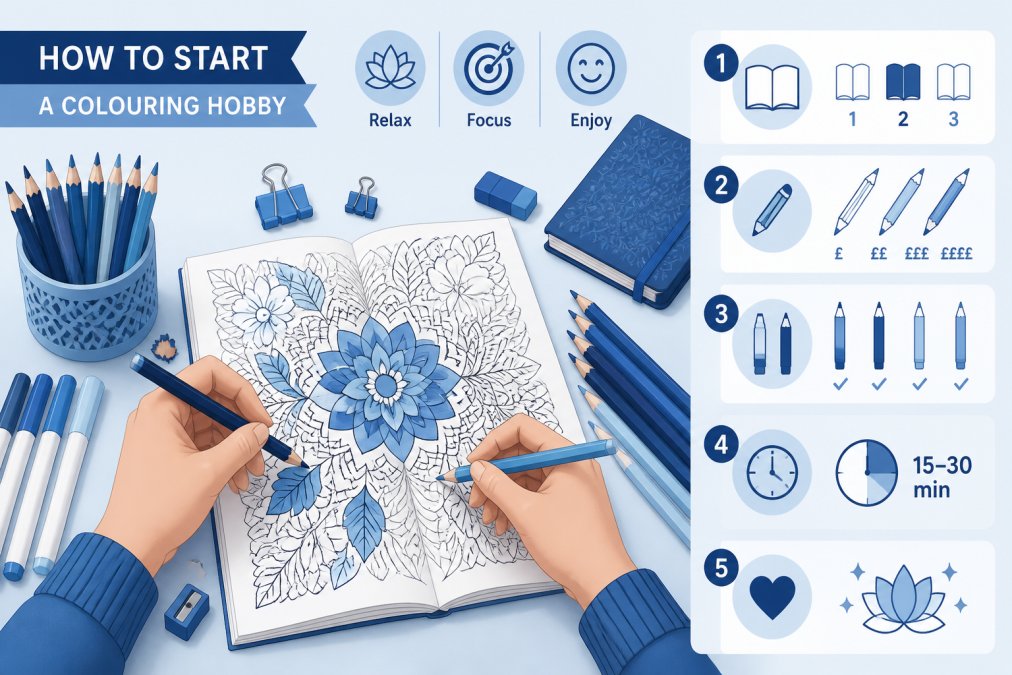
Your choice of colouring medium significantly affects your experience. Coloured pencils offer precision and control, making them ideal if you prefer staying within lines or working on detailed designs. They're portable and allow for layering colours to create subtle blends. Markers and felt-tip pens deliver instant, vibrant colour with minimal effort, though they can bleed through paper. Gel pens occupy a middle ground, offering precision with relatively quick colour application.
Your paper choice matters equally. Colouring books specifically designed for adults typically use better paper stock than children's colouring books, which supports a more satisfying experience. Start with materials that match your preferences and budget, then gradually invest in higher-quality materials as you discover what you enjoy most.
Creating a routine that works for you
The consistency of your colouring practice matters more than duration. Fifteen minutes daily delivers more benefit than occasional marathon sessions. A sustainable routine typically involves choosing a specific time and place and treating it as a non-negotiable appointment with yourself.
Your physical environment influences your experience. Natural lighting is preferable to harsh overhead lights. A comfortable chair and table at appropriate height prevent physical strain. Many people find that colouring works best as a transition activity, something that bridges between demanding tasks or between work and rest.
Adult Colouring Books for Neurodivergence and Special Needs
Colouring offers particular value for people with ADHD, autism spectrum conditions, dyspraxia, and other neurodivergent profiles. The structured nature of colouring, with clear boundaries and defined areas, reduces the cognitive load that often overwhelms neurodivergent individuals. The activity provides immediate, concrete feedback, which supports motivation and engagement.
For people with ADHD, colouring offers sustained focus without requiring the executive function demands of starting a project from scratch. The repetitive, rhythmic nature helps regulate dopamine and supports emotional stability. For autistic individuals, the sensory predictability of colouring can be deeply calming, providing controlled sensory input that you control entirely.
For individuals with anxiety disorders or trauma histories, colouring can serve as a grounding technique, a way to anchor awareness in the present moment when dissociation or intrusive thoughts threaten to overwhelm. The sensory engagement and focus required make colouring particularly effective for this purpose.
Integrating Colouring with Other Wellbeing Practices
Colouring works synergistically with other mental health and wellness approaches. Many therapists now recommend colouring as a complementary activity to formal therapy, particularly for processing emotions or managing anxiety between sessions. The non-verbal nature of colouring makes it valuable for people who find talking about emotions difficult.
Combining colouring with mindfulness meditation amplifies the benefits of both. You might begin with five minutes of formal meditation to settle your mind, then move into colouring to maintain that focused, present-moment awareness. For people managing chronic pain or illness, colouring provides a positive focus that doesn't require physical exertion.
The most important integration is simply making colouring a regular part of your self-care toolkit, not as a replacement for professional mental health support when needed, but as an accessible, immediate tool you can use daily to support your own wellbeing.
Adult colouring books represent an accessible, evidence-supported approach to managing anxiety, improving focus, and supporting emotional regulation. Whether you're seeking stress relief, creative expression, or simply a calming activity that fits your life, colouring offers genuine benefits without barriers to entry. Robs Books offers a carefully curated selection of adult colouring books designed with quality materials and thoughtful designs that support sustained engagement and enjoyment. Start with whatever appeals to you visually, commit to a simple routine, and notice how this quiet creative practice shifts your mental state and wellbeing over time.
Frequently Asked Questions
What are the main mental health benefits of adult colouring books?
Adult colouring books offer several psychological benefits, including stress and anxiety reduction, improved focus and concentration, and emotional regulation. The repetitive, focused nature of colouring activates a meditative state that helps calm the amygdala and lower cortisol levels. Many people find colouring provides a creative outlet for self-care and mental clarity, making it an accessible form of art therapy that requires no artistic skill.
How does colouring for anxiety relief actually work?
Colouring engages the prefrontal cortex while quieting the amygdala, the part of the brain responsible for fear and anxiety. This shift interrupts rumination and intrusive thoughts, creating a relaxation response similar to mindfulness. The sensory experience of holding pencils, choosing colours, and focusing on patterns activates fine motor skills and creates a mind-body connection that promotes emotional regulation and psychological comfort.
How long should you colour to see mental health benefits?
Research suggests that even 10-15 minutes of focused colouring can produce measurable stress relief and a calming effect. However, most people benefit from 20-30 minute sessions when possible. Consistency matters more than duration, a regular colouring practice, even for short periods several times a week, builds neuroplasticity and strengthens mental wellbeing over time. Start with whatever duration feels sustainable for your schedule.
Is adult colouring considered a form of meditation?
Yes, adult colouring can function as a form of meditation. When you focus on colour selection and pattern work, your mind enters a meditative state similar to mindfulness practice. This sustained attention to the present moment reduces stress and promotes mental clarity. However, colouring differs from traditional meditation in that it engages creative expression alongside contemplation, making it accessible to people who find sitting meditation challenging.
This article was written using GrandRanker
0 comments